Longitudinal Data Analysis#
This tutorial walks through a longitudinal clinical data analysis workflow:
EHRData for structured longitudinal clinical data handling
PyPOTS for time series classification on partially-observed clinical time series
ehrapy for data exploration, preprocessing, and visualization
PhysioNet 2012 Challenge dataset for in-hospital mortality prediction
Note
If you’re new to ehrapy and ehrdata, we strongly recommend reading Getting started with ehrdata and Introduction to ehrapy.
Environment setup#
import os
import warnings

warnings.filterwarnings("ignore")

# PyPOTS requires this for scipy compatibility
os.environ["SCIPY_ARRAY_API"] = "1"

import ehrapy as ep
import ehrdata as ed
import matplotlib.pyplot as plt
import numpy as np
import seaborn as sns
import torch
from pypots.classification import SAITS
from sklearn.metrics import accuracy_score, auc, confusion_matrix, f1_score, precision_recall_curve, roc_auc_score
from sklearn.model_selection import train_test_split

# Set random seeds for reproducibility
torch.manual_seed(42);

%matplotlib inline
import holoviews as hv

hv.extension("bokeh")

 ⓘ
ⓘ
Load PhysioNet 2012 Dataset#
edata = ed.dt.physionet2012(layer="tem_data")
edata
EHRData object with n_obs × n_vars × n_t = 11988 × 37 × 48
    obs: 'set', 'Age', 'Gender', 'Height', 'ICUType', 'SAPS-I', 'SOFA', 'Length_of_stay', 'Survival', 'In-hospital_death'
    var: 'Parameter'
    tem: '0', '1', '2', '3', '4', '5', '6', '7', '8', '9', '10', '11', '12', '13', '14', '15', '16', '17', '18', '19', '20', '21', '22', '23', '24', '25', '26', '27', '28', '29', '30', '31', '32', '33', '34', '35', '36', '37', '38', '39', '40', '41', '42', '43', '44', '45', '46', '47'
    layers: 'tem_data'
    shape of .tem_data: (11988, 37, 48)
Let’s inspect the data:
edata.obs.head()
| set | Age | Gender | Height | ICUType | SAPS-I | SOFA | Length_of_stay | Survival | In-hospital_death | |
|---|---|---|---|---|---|---|---|---|---|---|
| RecordID | ||||||||||
| 132539 | set-a | 54.0 | 0.0 | -1.0 | 4.0 | 6 | 1 | 5 | -1 | 0 |
| 132540 | set-a | 76.0 | 1.0 | 175.3 | 2.0 | 16 | 8 | 8 | -1 | 0 |
| 132541 | set-a | 44.0 | 0.0 | -1.0 | 3.0 | 21 | 11 | 19 | -1 | 0 |
| 132543 | set-a | 68.0 | 1.0 | 180.3 | 3.0 | 7 | 1 | 9 | 575 | 0 |
| 132545 | set-a | 88.0 | 0.0 | -1.0 | 3.0 | 17 | 2 | 4 | 918 | 0 |
And have a look at the features:
ed.infer_feature_types(edata, layer="tem_data")
 Detected feature types for EHRData object with 11988 obs and 37 vars
╠══ 📅 Date features
╠══ 📐 Numerical features
║   ╠══ ALP
║   ╠══ ALT
║   ╠══ AST
║   ╠══ Albumin
║   ╠══ BUN
║   ╠══ Bilirubin
║   ╠══ Cholesterol
║   ╠══ Creatinine
║   ╠══ DiasABP
║   ╠══ FiO2
║   ╠══ GCS
║   ╠══ Glucose
║   ╠══ HCO3
║   ╠══ HCT
║   ╠══ HR
║   ╠══ K
║   ╠══ Lactate
║   ╠══ MAP
║   ╠══ MechVent
║   ╠══ Mg
║   ╠══ NIDiasABP
║   ╠══ NIMAP
║   ╠══ NISysABP
║   ╠══ Na
║   ╠══ PaCO2
║   ╠══ PaO2
║   ╠══ Platelets
║   ╠══ RespRate
║   ╠══ SaO2
║   ╠══ SysABP
║   ╠══ Temp
║   ╠══ TroponinI
║   ╠══ TroponinT
║   ╠══ Urine
║   ╠══ WBC
║   ╠══ Weight
║   ╚══ pH
╚══ 🗂️ Categorical features
Exploratory Data Analysis#
We use ehrapy’s inspection tools to understand our cohort and data quality.
Quality control metrics with ehrapy#
Before diving into cohort tracking and missing value analysis, we compute quality control (QC) metrics using qc_metrics().
This adds missing-value statistics and summary statistics (mean, median, std, etc.) to edata.obs and edata.var, which supports downstream filtering and interpretation.
For longitudinal data we use the tem_data layer.
ep.pp.qc_metrics(edata, layer="tem_data")

print("Observation-level QC (first 5 rows):")
display(edata.obs[["missing_values_abs", "missing_values_pct"]].head())

print("\nVariable-level QC (first 40 rows):")
display(edata.var[["missing_values_pct", "mean", "median", "standard_deviation"]].head(40))
Observation-level QC (first 5 rows):
| missing_values_abs | missing_values_pct | |
|---|---|---|
| RecordID | ||
| 132539 | 1516 | 85.360360 |
| 132540 | 1375 | 77.421171 |
| 132541 | 1383 | 77.871622 |
| 132543 | 1418 | 79.842342 |
| 132545 | 1472 | 82.882883 |
Variable-level QC (first 40 rows):
| missing_values_pct | mean | median | standard_deviation | |
|---|---|---|---|---|
| Parameter | ||||
| ALP | 98.362077 | 120.142281 | 82.00 | 175.242311 |
| ALT | 98.315155 | 362.919577 | 42.00 | 1133.465814 |
| AST | 98.314982 | 504.997937 | 62.00 | 1649.590278 |
| Albumin | 98.741797 | 2.890663 | 2.90 | 0.651872 |
| BUN | 92.757688 | 27.171867 | 20.00 | 22.600949 |
| Bilirubin | 98.298125 | 2.864883 | 0.90 | 5.770600 |
| Cholesterol | 99.827258 | 155.682093 | 153.00 | 44.460024 |
| Creatinine | 92.724843 | 1.473213 | 1.00 | 1.550207 |
| DiasABP | 45.804833 | 59.547250 | 58.00 | 13.073717 |
| FiO2 | 84.296971 | 0.541265 | 0.50 | 0.188191 |
| GCS | 67.940858 | 11.415181 | 13.00 | 3.993081 |
| Glucose | 93.174598 | 140.844965 | 127.00 | 65.012700 |
| HCO3 | 92.911488 | 23.154983 | 23.00 | 4.721876 |
| HCT | 90.495183 | 30.691727 | 30.20 | 5.001046 |
| HR | 9.786696 | 86.615487 | 86.00 | 17.858740 |
| K | 92.411856 | 4.128653 | 4.00 | 0.680830 |
| Lactate | 95.883036 | 2.954756 | 2.10 | 2.565953 |
| MAP | 46.114170 | 80.269169 | 78.00 | 16.432571 |
| MechVent | 84.923813 | 1.000000 | 1.00 | 0.000000 |
| Mg | 92.902277 | 2.023403 | 2.00 | 0.516253 |
| NIDiasABP | 57.925808 | 58.354169 | 57.00 | 15.206178 |
| NIMAP | 58.505728 | 77.358974 | 76.00 | 15.061055 |
| NISysABP | 57.888096 | 119.687100 | 117.00 | 22.430955 |
| Na | 92.895500 | 139.105208 | 139.00 | 5.213751 |
| PaCO2 | 88.459988 | 40.392285 | 39.00 | 9.126968 |
| PaO2 | 88.481016 | 147.545456 | 121.00 | 85.567716 |
| Platelets | 92.629609 | 189.955339 | 172.00 | 107.097081 |
| RespRate | 75.935832 | 19.589149 | 19.00 | 5.487177 |
| SaO2 | 95.984526 | 96.689699 | 97.00 | 3.507824 |
| SysABP | 45.800836 | 119.892138 | 118.00 | 23.952596 |
| Temp | 62.870162 | 37.079814 | 37.10 | 1.425589 |
| TroponinI | 99.795803 | 8.210383 | 3.30 | 10.968970 |
| TroponinT | 98.914192 | 1.174704 | 0.18 | 2.786282 |
| Urine | 30.718392 | 115.918911 | 70.00 | 158.601586 |
| WBC | 93.265835 | 12.934450 | 11.50 | 10.473903 |
| Weight | 47.147147 | 83.091312 | 80.00 | 25.130950 |
| pH | 87.664401 | 7.312456 | 7.38 | 4.939904 |
We can see at a glance:
what percentage of measurements are available on an observation (person) level
what percentage of measurements are available on a variable level
For the persons, we see from the sample of the first 5 individuals that the missing value percentage, or in other words the monitoring intensity, can vary.
For the variables, we obtain summary statistics (mean, standard deviation) and can spot outliers. The dataset records up to 48 hourly measurements per patient.
The basic physiological measurements — DiasABP, HR, MAP, NIDiasABP, NIMAP, NISysABP, SysABP, Urine, and Weight — are most frequently recorded.
More specific measurements like WBC and TroponinI are less frequently measured.
Variable Correlations#
After inspecting individual variable quality, we can examine pairwise correlations between variables. This helps identify redundant features, clinically expected relationships, and potential confounders before any preprocessing is applied. Note that correlation estimates for variables with higher missingness are based on fewer observations.
ep.pl.variable_correlations(
    edata,
    layer="tem_data",
    method="pearson",
    correction_method="fdr_bh",
    agg="mean",
    show_values=False,
    width=800,
    height=800,
)
:HeatMap [variable1,variable2] (correlation,label)
Cohort Tracking with CohortTracker#
Let us examine the information of the cohort in more detail.
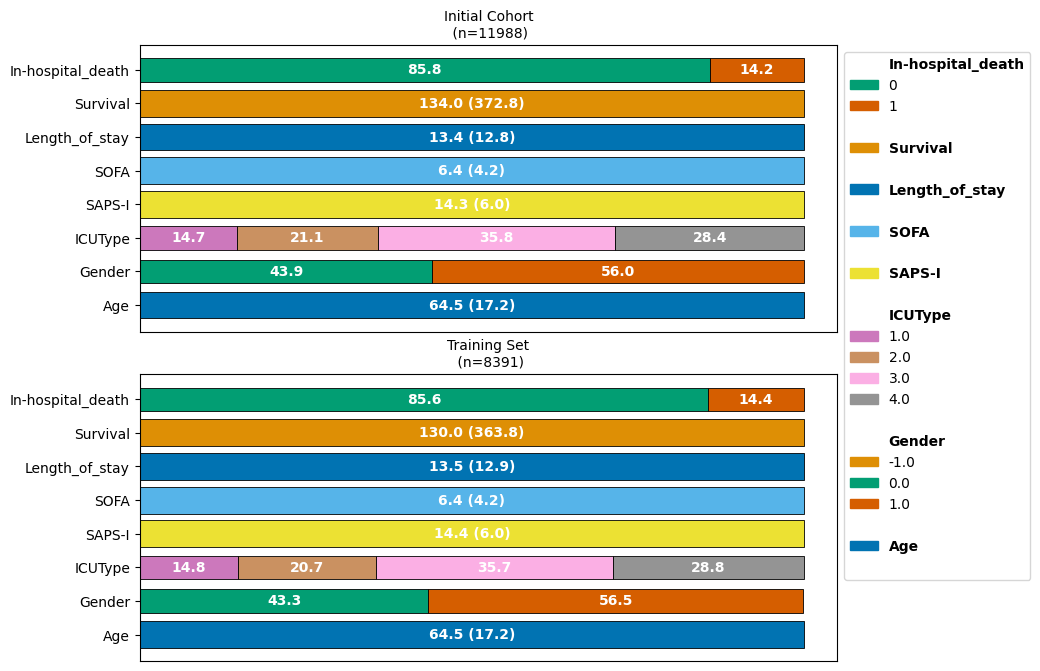
ehrapy’s CohortTracker records how the cohort changes through each processing step, allowing us to visualize the full pipeline at the end.
tracking_cols = ["Age", "Gender", "ICUType", "SAPS-I", "SOFA", "Length_of_stay", "Survival", "In-hospital_death"]
categorical_cols = ["Gender", "ICUType", "In-hospital_death"]

ct = ep.tl.CohortTracker(edata, columns=tracking_cols, categorical=categorical_cols)
ct(edata, label="Initial Cohort", operations_done="Loaded PhysioNet 2012 dataset")
ct.plot_cohort_barplot()
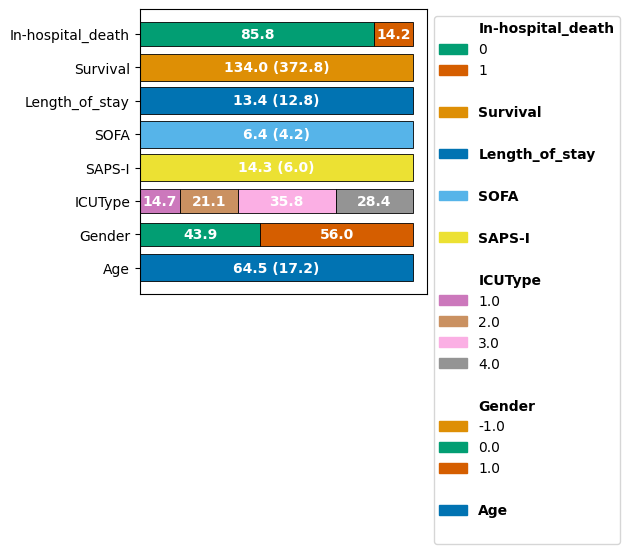
We can observe that on average, patients are 64.5 years old upon ICU entry, with slightly more females (0) than males (1).
Sankey Diagrams for Patient Flow#
We can further inspect variables with a Sankey diagram:
ep.pl.sankey_diagram(
    edata,
    columns=["Gender", "In-hospital_death"],
    title="Patient Flow: Gender to Sepsis Status",
)
Where we can obtain a quick visual cue about e.g. the relation of Gender and In-hospital_death.
Here, there is no immediate indication that these two variables are strongly associated in our cohort.
We can also inspect variables longitudinally for how patients change along the time axis. A Sankey diagram is for categorical variables. Since our time-series data consists of continuous variables, we create a quick example with categorized values.
For this, let us explore the heart rate HR, which we bin for a rough overview into low, normal, high, and missing.
# create a new layer in edata
edata.layers["cat_hr"] = edata.layers["tem_data"].copy()

# fill the HR variable (index 14) with the categorical values
edata.layers["cat_hr"][:, 14, :] = np.where(
    edata.layers["tem_data"][:, 14, :] < 60, 0, edata.layers["cat_hr"][:, 14, :]
)
edata.layers["cat_hr"][:, 14, :] = np.where(
    edata.layers["tem_data"][:, 14, :] >= 100, 2, edata.layers["cat_hr"][:, 14, :]
)
edata.layers["cat_hr"][:, 14, :] = np.where(
    (edata.layers["tem_data"][:, 14, :] >= 60) & (edata.layers["tem_data"][:, 14, :] <= 100),
    1,
    edata.layers["cat_hr"][:, 14, :],
)
edata.layers["cat_hr"][:, 14, :] = np.where(
    np.isnan(edata.layers["tem_data"][:, 14, :]), 3, edata.layers["cat_hr"][:, 14, :]
)
Let’s visualize these HR categories for the first 5 hours:
# plot the Sankey diagram
ep.pl.sankey_diagram_time(
    edata[:, :, :5],
    var_name="HR",
    layer="cat_hr",
    state_labels={0: "Low HR", 1: "Normal HR", 2: "High HR", 3: "Missing HR"},
    width=700,
)
We can see that most patients at hour 0 (leftmost) have no HR measurement.
Further, most patients with measured HR display a normal measurement at hour 0.
We can observe that the fraction of patients with no HR measurement at every hour declines as their ICU stay proceeds.
Time Series Visualization#
For exploring continuous variables across time, ehrapy provides timeseries().
Let’s look at a few vital parameters for the first two patients:
vital_vars = ["HR", "SaO2", "Temp", "NISysABP", "NIDiasABP", "RespRate"]

ep.pl.timeseries(
    edata[:2],
    layer="tem_data",
    var_names=vital_vars,
)
We can see that the measurements of vital signs can be very irregular, and different for different individuals.
While individual 132540 had their HR constantly monitored, no data on their RespRate is available.
Individual 132539 on the other hand has HR and RespRate data available, but multiple gaps where none of these values were acquired.
Normalization#
Variables have different scales and units.
To focus on within-feature deviation from the population mean rather than on numeric magnitude, we normalize.
ehrapy offers multiple normalization approaches; here we use scale_norm() which applies standard (z-score) normalization per feature.
edata.layers["norm_data"] = edata.layers["tem_data"].copy()
ep.pp.scale_norm(edata, layer="norm_data")

vital_vars = ["HR", "SaO2", "Temp", "NISysABP", "NIDiasABP", "RespRate"]
ep.pl.timeseries(
    edata[:2],
    layer="norm_data",
    var_names=vital_vars,
)
Imputation#
Clinical time series are often sparsely observed: a patient’s heart rate may be recorded every few minutes, while a lab value like creatinine is only drawn once a day. Last Observation Carried Forward (LOCF) is a simple imputation strategy that fills each missing time point with the most recent observed value, mimicking the clinical assumption that a measurement remains valid until the next reading.
For values missing at the start of the time window (before any observation exists), a fallback_method is used.
Here we fall back to the per-feature mean so that no NaNs remain for downstream steps.
ehrapy provides locf_impute() for this directly on 3D EHRData layers:
edata.layers["locf_data"] = edata.layers["norm_data"].copy()
ep.pp.locf_impute(edata, layer="locf_data", fallback_method="mean")

vital_vars = ["HR", "SaO2", "Temp", "NISysABP", "NIDiasABP", "RespRate"]
ep.pl.timeseries(
    edata[:2],
    layer="locf_data",
    var_names=vital_vars,
)
After LOCF imputation the gaps are filled with the last observed reading: plateaus in the time series correspond to periods where a value was carried forward. The initial period (before the first observation) is filled using the population mean as fallback.
Temporal representations#
To build a 2D patient-by-feature representation from 3D longitudinal data, we aggregate each variable’s time series into summary statistics (mean and standard deviation across time). This captures both the central tendency and variability of each clinical variable across the full 48-hour stay without relying on an arbitrary single time point.
We use the LOCF-imputed layer from above so that the statistics reflect carried-forward measurements rather than ignoring gaps.
mean_rep = np.nanmean(edata.layers["locf_data"], axis=2)
std_rep = np.nanstd(edata.layers["locf_data"], axis=2)
edata.obsm["temporal_rep"] = np.hstack([mean_rep, std_rep])

ep.pp.neighbors(edata, n_neighbors=15, use_rep="temporal_rep", key_added="temporal_neighbors")
ep.tl.leiden(edata, neighbors_key="temporal_neighbors", key_added="temporal_leiden", resolution=0.2, random_state=0)
ep.tl.umap(edata, neighbors_key="temporal_neighbors")
ep.pl.umap(edata, color=["Gender", "ICUType", "In-hospital_death", "temporal_leiden"], show=False);

Rank features groups#
We identify which static features differ across the Leiden clusters using ep.tl.rank_features_groups.
This helps us understand what patient characteristics the unsupervised clustering has captured.
ep.tl.rank_features_groups(
    edata,
    field_to_rank="obs",
    columns_to_rank={"obs_names": ["Age", "Gender", "SAPS-I", "SOFA", "Length_of_stay", "missing_values_pct"]},
    groupby="temporal_leiden",
    key_added="rank_features_groups",
)
ep.pl.rank_features_groups(edata, key="rank_features_groups", n_features=10, show=False);
! Detected no columns that need to be encoded. Leaving passed EHRData object unchanged.
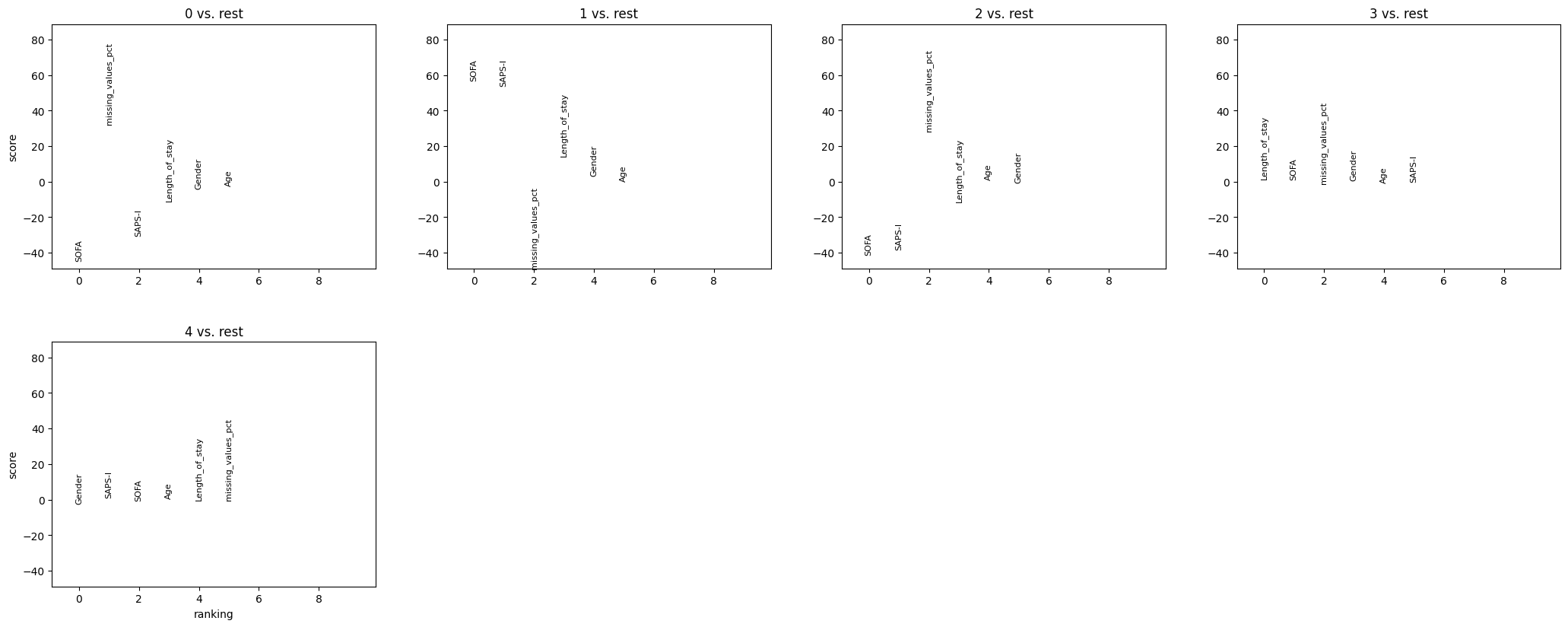
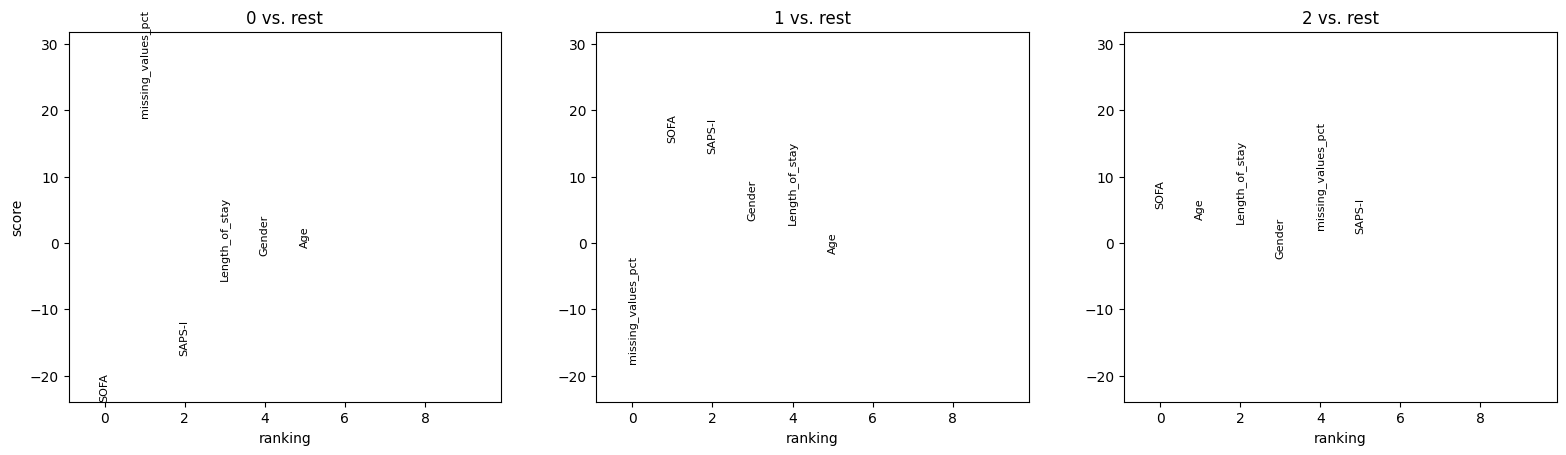
The Leiden clustering, defined entirely on dynamic variables, subgroups patients by severity scores (SOFA, SAPS-I) and monitoring intensity (missing value percentage).
Machine Learning with SAITS#
Having explored the data and built unsupervised representations, we now train a deep learning classifier to predict in-hospital mortality.
SAITS (Self-Attention-based Imputation for Time Series) is designed for classification on partially-observed time series, making it well-suited for clinical data where missing values are common. It uses diagonal masked self-attention (DMSA) to jointly handle missingness patterns and temporal dependencies. See the PyPOTS documentation for details.
Data splitting#
train_indices = np.arange(len(edata))
train_idx, temp_idx = train_test_split(
    train_indices,
    test_size=0.3,
    random_state=42,
    stratify=edata.obs["SepsisLabel"] if "SepsisLabel" in edata.obs.columns else None,
)
val_idx, test_idx = train_test_split(
    temp_idx,
    test_size=0.5,
    random_state=42,
    stratify=edata.obs.iloc[temp_idx]["SepsisLabel"] if "SepsisLabel" in edata.obs.columns else None,
)

edata_train = edata[train_idx].copy()
edata_val = edata[val_idx].copy()
edata_test = edata[test_idx].copy()

# Track cohort changes
ct(edata_train, label="Training Set", operations_done="Split into train/val/test")
SAITS model configuration#
We configure SAITS for the PhysioNet 2012 dataset:
Sequence length: 48 hourly steps, 37 clinical variables
Binary classification: in-hospital mortality
DMSA architecture: 2 layers,
d_model=64,n_heads=4
ep.settings.verbosity = "error"

# Initialize SAITS classifier
n_timesteps = edata_train.shape[2]
n_features = edata_train.shape[1]
n_classes = 2  # Binary classification: in-hospital death vs. no in-hospital death

# SAITS architecture: d_model must be divisible by n_heads, d_k = d_model / n_heads
d_model = 64
n_heads = 4
d_k = d_v = d_model // n_heads  # 16

# Initialize SAITS with PyPOTS defaults and reasonable training settings
saits = SAITS(
    n_steps=n_timesteps,
    n_features=n_features,
    n_classes=n_classes,
    # Architecture parameters required by SAITS
    n_layers=2,
    d_model=d_model,
    n_heads=n_heads,
    d_k=d_k,
    d_v=d_v,
    d_ffn=128,
    dropout=0.1,
    attn_dropout=0.1,
    diagonal_attention_mask=True,  # DMSA
    # Training configuration
    epochs=4,
    batch_size=32,
    patience=1,
    device="cuda" if torch.cuda.is_available() else "cpu",
    saving_path="./saits_model",  # Save model checkpoints
)

print(f"\nUsing device: {saits.device}")
print(f"Model initialized with {sum(p.numel() for p in saits.model.parameters())} parameters")
Training#
saits.fit(
    train_set={
        "X": edata_train.layers["norm_data"].transpose(0, 2, 1),
        "y": edata_train.obs["In-hospital_death"].values,
    },
    val_set={"X": edata_val.layers["norm_data"].transpose(0, 2, 1), "y": edata_val.obs["In-hospital_death"].values},
)
Model Evaluation#
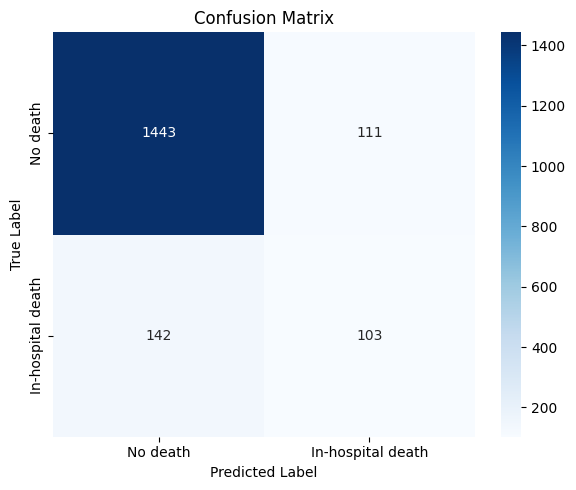
We evaluate the trained model on the held-out test set using standard classification metrics.
# Evaluate the trained SAITS classifier on the test set
test_predictions = saits.predict({"X": edata_test.layers["norm_data"].transpose(0, 2, 1)})
test_pred_labels = test_predictions["classification"]
test_pred_proba = test_predictions["classification_proba"]

y_test = edata_test.obs["In-hospital_death"]
roc_auc = roc_auc_score(y_test, test_pred_proba[:, 1])
precision, recall, _ = precision_recall_curve(y_test, test_pred_proba[:, 1])
pr_auc = auc(recall, precision)
f1 = f1_score(y_test, test_pred_labels)
accuracy = accuracy_score(y_test, test_pred_labels)

print(f"ROC-AUC: {roc_auc:.4f} | PR-AUC: {pr_auc:.4f} | F1: {f1:.4f} | Accuracy: {accuracy:.4f}")

cm = confusion_matrix(y_test, test_pred_labels)
plt.figure(figsize=(6, 5))
sns.heatmap(
    cm,
    annot=True,
    fmt="d",
    cmap="Blues",
    xticklabels=["No death", "In-hospital death"],
    yticklabels=["No death", "In-hospital death"],
)
plt.title("Confusion Matrix")
plt.ylabel("True Label")
plt.xlabel("Predicted Label")
plt.tight_layout()
plt.show()
ROC-AUC: 0.8372 | PR-AUC: 0.4861 | F1: 0.4488 | Accuracy: 0.8594
# Plot ROC and PR curves
fig, (ax1, ax2) = plt.subplots(1, 2, figsize=(14, 5))

# ROC Curve
from sklearn.metrics import roc_curve

fpr, tpr, _ = roc_curve(y_test, test_pred_proba[:, 1])
ax1.plot(fpr, tpr, label=f"SAITS (AUC = {roc_auc:.3f})", linewidth=2)
ax1.plot([0, 1], [0, 1], "k--", label="Random")
ax1.set_xlabel("False Positive Rate", fontsize=12)
ax1.set_ylabel("True Positive Rate", fontsize=12)
ax1.set_title("ROC Curve", fontsize=14)
ax1.legend(fontsize=11)
ax1.grid(alpha=0.3)

# PR Curve
ax2.plot(recall, precision, label=f"SAITS (AUC = {pr_auc:.3f})", linewidth=2)
baseline = y_test.mean()
ax2.plot([0, 1], [baseline, baseline], "k--", label=f"Baseline ({baseline:.3f})")
ax2.set_xlabel("Recall", fontsize=12)
ax2.set_ylabel("Precision", fontsize=12)
ax2.set_title("Precision-Recall Curve", fontsize=14)
ax2.legend(fontsize=11)
ax2.grid(alpha=0.3)

plt.tight_layout()
plt.show()
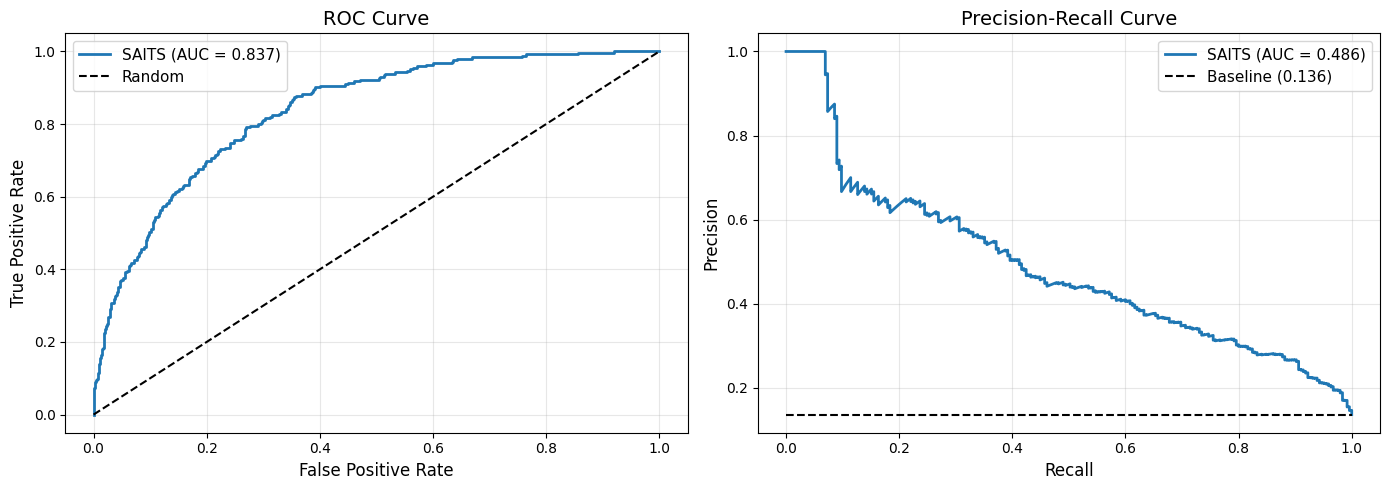
The label imbalance — far more survivors than non-survivors — biases the model towards predicting “no in-hospital death”. The PR curve gives a more informative view of performance on the minority class than the ROC curve.
Exploring SAITS representations#
Beyond classification, we can extract the internal representations that SAITS learns.
These embeddings encode temporal patterns learned in a supervised fashion, in contrast to the simple statistical aggregation from before.
We store them in .obsm and apply the same neighborhood / Leiden / UMAP workflow.
data = edata_test.layers["tem_data"].transpose(0, 2, 1).copy()
missing_mask = np.isnan(data)
data[missing_mask] = 0
data = torch.tensor(data, dtype=torch.float32)

_, _, X_tilde_3, _, _, _ = saits.model.encoder(
    torch.tensor(data, dtype=torch.float32),
    torch.tensor(missing_mask, dtype=torch.float32),
    None,
)

edata_test.obsm["saits_embedding"] = X_tilde_3.mean(dim=1).detach().numpy()

ep.pp.neighbors(edata_test, use_rep="saits_embedding", key_added="saits_neighbors", n_neighbors=15)
ep.tl.leiden(edata_test, neighbors_key="saits_neighbors", key_added="saits_leiden", resolution=0.2, random_state=0)
ep.tl.umap(edata_test, neighbors_key="saits_neighbors")
ep.pl.umap(
    edata_test,
    color=["In-hospital_death", "temporal_leiden", "saits_leiden"],
    show=False,
);
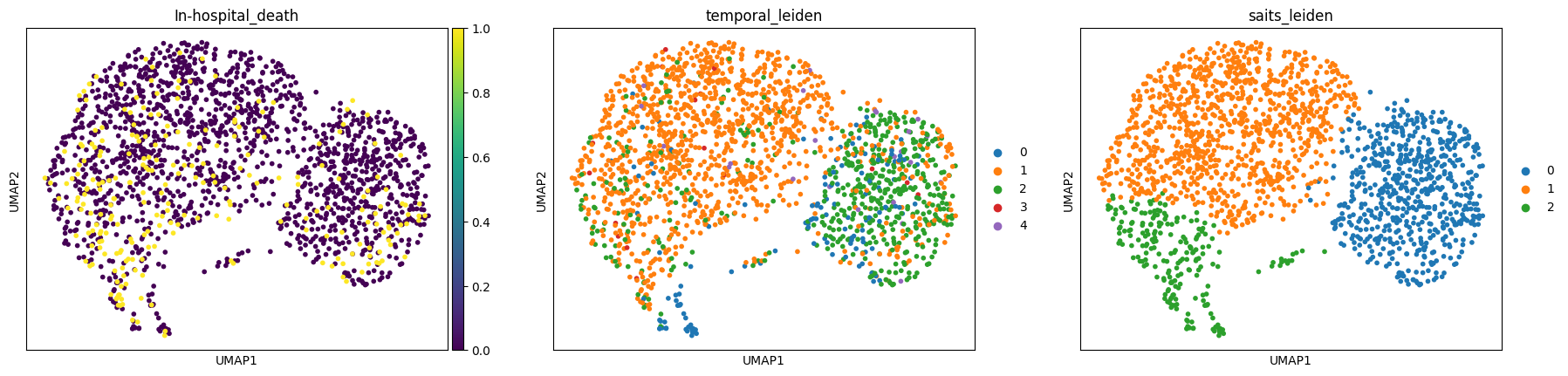
Comparing the unsupervised temporal-statistic clustering with the supervised SAITS-based clustering reveals how much additional structure the model captures from the mortality signal.
ep.tl.rank_features_groups(
    edata_test,
    field_to_rank="obs",
    columns_to_rank={"obs_names": ["Age", "Gender", "SAPS-I", "SOFA", "Length_of_stay", "missing_values_pct"]},
    groupby="saits_leiden",
    key_added="rank_features_groups",
)
ep.pl.rank_features_groups(edata_test, key="rank_features_groups", n_features=10, show=False);
Cohort Tracking Summary#
Finally, we can visualize how the cohort changed throughout the full analysis pipeline using the CohortTracker we initialized earlier.
ct.plot_cohort_barplot(
    subfigure_title=True,
    show=True,
    fontsize=10,
    subplots_kwargs={
        "figsize": (9, 8),
        "gridspec_kw": {"wspace": 0.15, "hspace": 0.15},
    },
)