
ehrapy: electronic health record (EHR) analysis in Python#
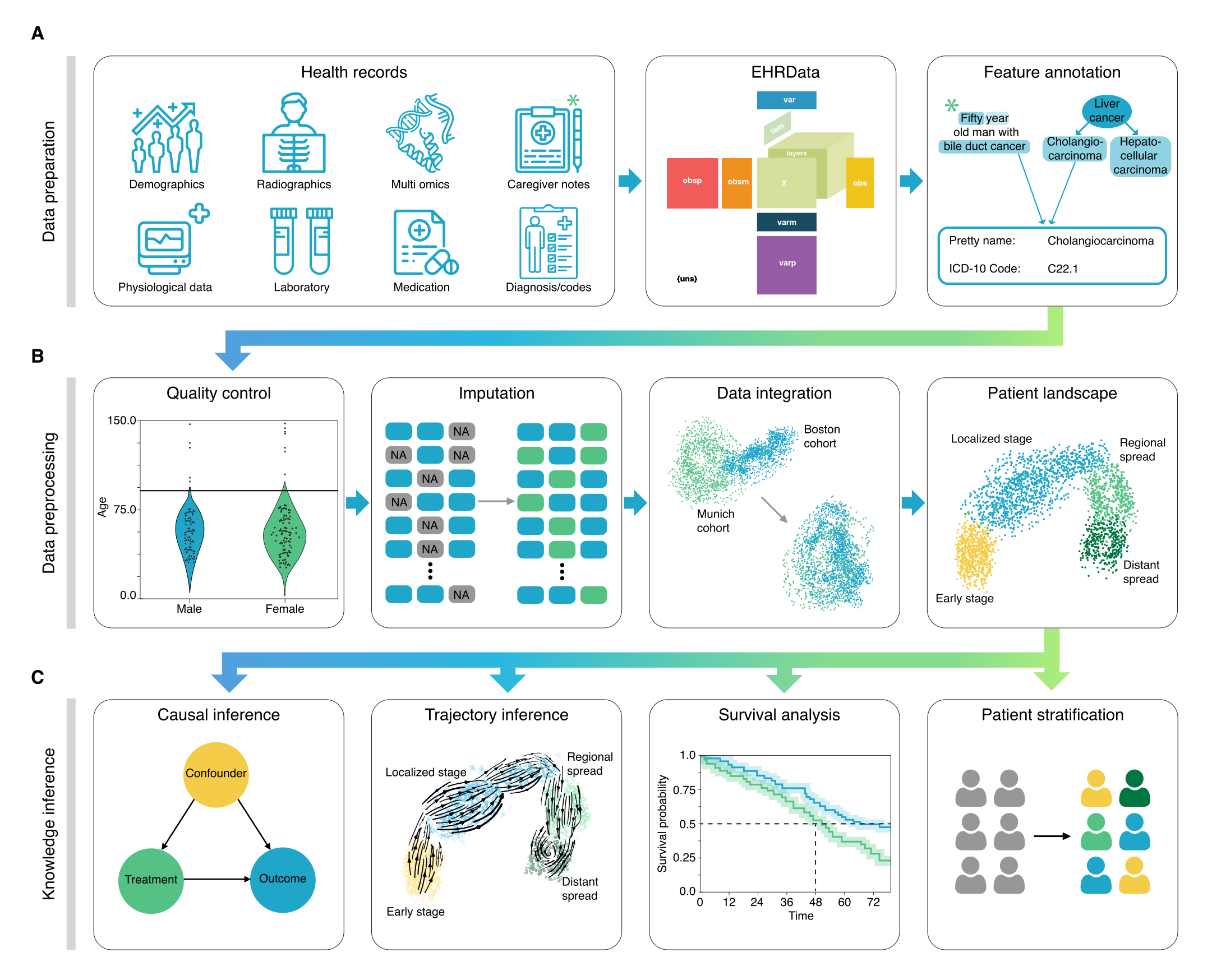
ehrapy is an open-source Python framework for exploratory and statistical analysis of electronic health records (EHR) and other clinical and epidemiological data.
It reads static and longitudinal patient data from OMOP databases, public datasets such as MIMIC and PhysioNet, or your own tables.
It covers quality control, imputation, normalization, clustering, trajectory inference, survival analysis, causal inference and fairness checks in one reproducible workflow.
With ep.ml, it also trains and evaluates prediction models, from gradient boosting to recurrent and transformer networks, with patient-level splits, calibration and subgroup metrics.
New to ehrapy? Check out the installation guide.
The API reference contains a detailed description of the ehrapy API.
The tutorials walk you through real-world applications of ehrapy.
Need help? Reach out on our forum to get your questions answered!
Found a bug? Interested in improving ehrapy? Checkout our GitHub for the latest developments.
Citation#

Read more about ehrapy in the associated publication.
@article{Heumos2024,
  author = {Heumos, Lukas and Ehmele, Philipp and Treis, Tim and Upmeier zu Belzen, Julius and Roellin, Eljas and May, Lilly and Namsaraeva, Altana and Horlava, Nastassya and Shitov, Vladimir A. and Zhang, Xinyue and Zappia, Luke and Knoll, Rainer and Lang, Niklas J. and Hetzel, Leon and Virshup, Isaac and Sikkema, Lisa and Curion, Fabiola and Eils, Roland and Schiller, Herbert B. and Hilgendorff, Anne and Theis, Fabian J.},
  year = {2024},
  month = {11},
  day = {01},
  title = {An open-source framework for end-to-end analysis of electronic health record data},
  journal = {Nature Medicine},
  volume = {30},
  number = {11},
  pages = {3369--3380},
  issn = {1546-170X},
  doi = {10.1038/s41591-024-03214-0},
  url = {https://doi.org/10.1038/s41591-024-03214-0}
}